Business owners have been urged to look at the combined impact of Budget 2026 on their companies, personal finances and long-term plans, as changes to savings, property income, pensions and business disposals create new considerations for families and investors.
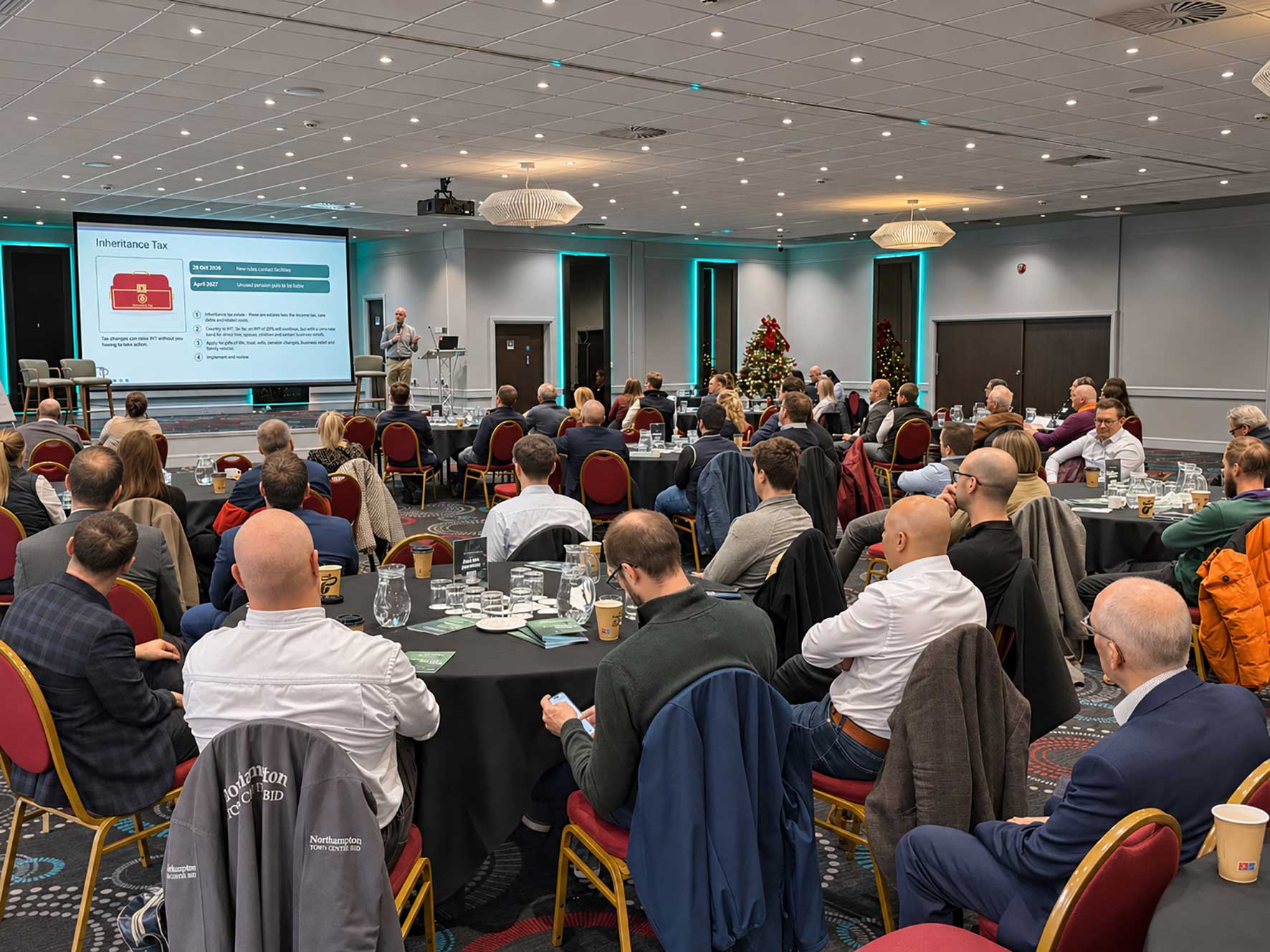
Around 100 people attended an Autumn Budget briefing last week hosted by Cottons Group at the Mercure Northampton, where specialists examined the tax changes and the financial decisions facing business owners over the coming years.
The briefing, introduced by Cottons Group partner Sarah Randall, brought together tax partner Luke Prout and Giedre Azukaite, chartered financial planner at the firm’s newly launched Cottons Wealth service.
While the main rates of corporation tax remain unchanged, the Budget contains measures affecting how individuals receive income, build wealth, transfer assets and eventually exit their businesses.
For someone who owns a company, receives rental income and holds a pension intended for their family, several of the changes could apply simultaneously, although their financial consequences will depend on individual circumstances.
From April 2027, the basic, higher and additional rates of income tax on savings and property income are set to rise to 24%, 44% and 49% respectively.
The increases could affect landlords and individuals holding substantial cash savings outside tax-efficient arrangements. They also raise questions about how investment income is structured and whether existing arrangements remain appropriate.
Prout discussed the use of limited companies for property investment, particularly where landlords have significant borrowing or intend to retain profits for reinvestment.
However, he cautioned against assuming that transferring properties into a company would automatically produce a better outcome. Capital gains tax, stamp duty and the costs of restructuring can make incorporation unsuitable in some circumstances.
For savers, the annual Individual Savings Account allowance remains at £20,000, providing an opportunity to shelter eligible savings and investments from income tax and capital gains tax.
The Budget also includes changes affecting people earning additional income through smaller trading activities, with the trading allowance increasing from £1,000 to £3,000 from April 2027.
Business owners considering retirement or the sale of their companies face a separate set of decisions.
From 6 April 2027, the lifetime limit for Business Asset Disposal Relief is due to fall from £1 million to £500,000.
The relief provides a reduced capital gains tax rate of 18% on qualifying disposals. Reducing the lifetime limit will halve the maximum potential tax saving against the main 24% capital gains tax rate, from £60,000 to £30,000.
Prout explained that the change makes early planning important for owners considering a sale, management buyout or transfer of ownership.
However, he warned against allowing the tax deadline to dictate the commercial decision. Selling a business prematurely to secure a £30,000 tax saving could prove costly if the owner subsequently accepts a substantially lower purchase price.
Preparing a business for sale also involves more than reviewing its tax position.
Prout highlighted the importance of reducing a company’s dependence on its founder, strengthening management arrangements and resolving issues that could emerge during a purchaser’s due diligence.
Businesses that can operate successfully without their owners’ day-to-day involvement may be more attractive to potential buyers.
The Budget also proposes a new Founders’ Relief, offering a 10% capital gains tax rate on up to £10 million of lifetime gains for qualifying founders and early investors in high-growth companies.
The proposed eligibility conditions are restrictive and subject to consultation, meaning the relief is unlikely to apply to every entrepreneur or established family business.
For companies seeking to attract and retain employees, Prout also discussed developments in tax-advantaged share schemes, including Enterprise Management Incentives and proposed changes to other share option arrangements.
Such schemes can allow employees to benefit from future business growth while giving employers greater flexibility over when shares are acquired.
Investment reliefs remain another important consideration.
The Annual Investment Allowance continues to provide qualifying businesses with up to £1 million of relief on eligible expenditure, while full expensing allows companies to deduct the cost of certain qualifying investments immediately.
Prout also highlighted Patent Box relief, which can reduce corporation tax on profits attributable to qualifying patented inventions.
He described a client whose patented product had previously been overlooked for the relief. A subsequent review identified approximately £300,000 in corporation tax savings.
Alongside the business measures, changes to inheritance tax are prompting individuals to reconsider their retirement and estate planning.
From April 2027, most unused pension funds and certain pension death benefits will be brought within the scope of inheritance tax.
The change could have significant implications for families who have previously treated pensions as a way of passing wealth to the next generation.
Azukaite explained that pensions remain an important tax-efficient way of saving for retirement, despite the forthcoming inheritance tax changes.
However, individuals may need to reconsider the order in which they draw on pensions, savings and other investments, particularly where inheritance planning has influenced previous decisions.
She also encouraged people to review pension beneficiary nominations and consider how their retirement income, investments and wider estate arrangements work together.
For business owners contemplating a future sale, Azukaite raised a question that is sometimes overlooked: how much money will they actually need?
A business may have an attractive market valuation, but that does not necessarily establish whether the proceeds will be sufficient to support the owner’s desired retirement lifestyle.
Financial planning and cash-flow modelling can help assess future spending, investment returns, longevity and potential financial risks before an owner commits to a particular exit strategy.
The relationship between business decisions and personal wealth planning was a central theme of the briefing.
Cottons Group has recently introduced Cottons Wealth, bringing financial planning alongside its existing tax, accounting and corporate advisory services.
The service reflects the growing overlap between decisions about business ownership, investment income, retirement and inheritance.
During the closing question-and-answer session, attendees raised concerns about transferring rental properties into companies, making substantial gifts to family members, pension withdrawals and whether business disposals should be accelerated ahead of April 2027.
Prout acknowledged the uncertainty created by successive changes to tax policy, but emphasised the importance of retaining flexibility when making long-term arrangements.
He explained that planning should take account of commercial objectives and family circumstances, rather than simply seeking the largest immediate tax saving.
For business owners, the Budget’s implications may therefore extend well beyond the company tax bill. Decisions about investment, succession, retirement and passing wealth to the next generation increasingly need to be considered together.
Pictured: Cottons Group tax partner Luke Prout discussed the business and personal tax implications of Budget 2026 at the Mercure Northampton.