At 39, Jonathan Newman was told that the football he had played for most of his life had become too dangerous.
Four years later, the Northamptonshire coach is building a football community around people who, like him, are not ready to hang up their boots simply because traditional football no longer works for them.
It is not quite how he planned his next move.
Newman had suffered a TIA, or small stroke, in December 2022 after returning home from coaching at Moulton School. Active, coaching regularly and still playing adult five-a-side, he suddenly found himself taking daily medication and being advised to avoid competitive football where a heavy tackle or collision could have serious consequences.
The medical advice removed more than exercise from his week.
Football had been part of Newman’s life since childhood in Harpole, later becoming the means through which he and his eldest son Josh became part of the Brixworth community. He spent ten years coaching at Brixworth Juniors, served on its committee and built friendships around the club.
It had also become important to his mental wellbeing.
Newman has experienced anxiety and agoraphobia at different stages of his life and says football gave him a combination that was difficult to replicate elsewhere: exercise, competition, companionship, routine and an hour in which attention was concentrated on the game rather than everything beyond it.
So, after his stroke, he began looking for a way to continue playing.
Walking football appeared the obvious answer. There was one difficulty.
He was too young for much of what he found.
“At the time, walking football seemed to be aimed predominantly at much older players,” he says.
For a man of 39 who wanted the game without the physical risks of traditional five-a-side, there appeared to be an awkward gap.
Newman carried on coaching and returned gradually to normal life. But the unanswered question stayed with him.
It resurfaced this year almost by accident.
After finishing his decade with Brixworth Juniors, Newman started NewMan Active, initially offering football coaching for children with an emphasis on confidence, exercise and wellbeing.
He hired a sports hall at Guilsborough Academy for a weekly session aimed at seven to 12-year-olds.
Two children turned up.
One was his son.
The other was his son’s best friend.
It was not an especially encouraging piece of market research.
But Newman had already paid for the hall. With four people there, including his helper, they tried a game of walking football instead.
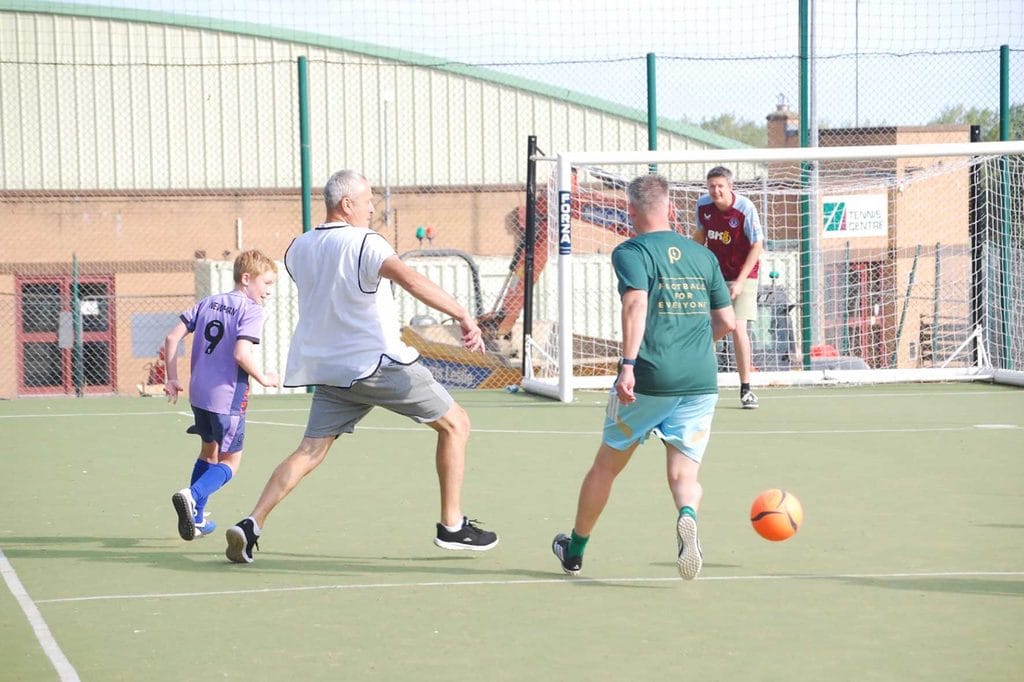
He went home with a different idea.
A Facebook post asking whether anybody would be interested produced around 15 to 20 responses. Six or seven attended the first proper session. Within six weeks, as many as 13 were playing on a Friday.
That response turned a failed children’s session into the beginnings of Play Footy FC.
Conversations with Phil Andrews of Moulton Walking Football Club and James Geddis at Northamptonshire FA strengthened Newman’s belief that there was room for something aimed at people who did not necessarily fit the traditional picture of a walking football player.
“What about somebody in their 40s who has had a stroke? Or a heart attack?” he says.
“What about someone whose knees won’t cope with running around a football pitch any more, but who still loves football?”
It is a deceptively simple proposition.
Britain is full of adults who spent their younger years playing sport before work, children, injuries and ageing joints gradually pushed it out of their lives. Newman knows many of them because he spent years standing beside them while their children played.
Now some are putting their own boots back on.
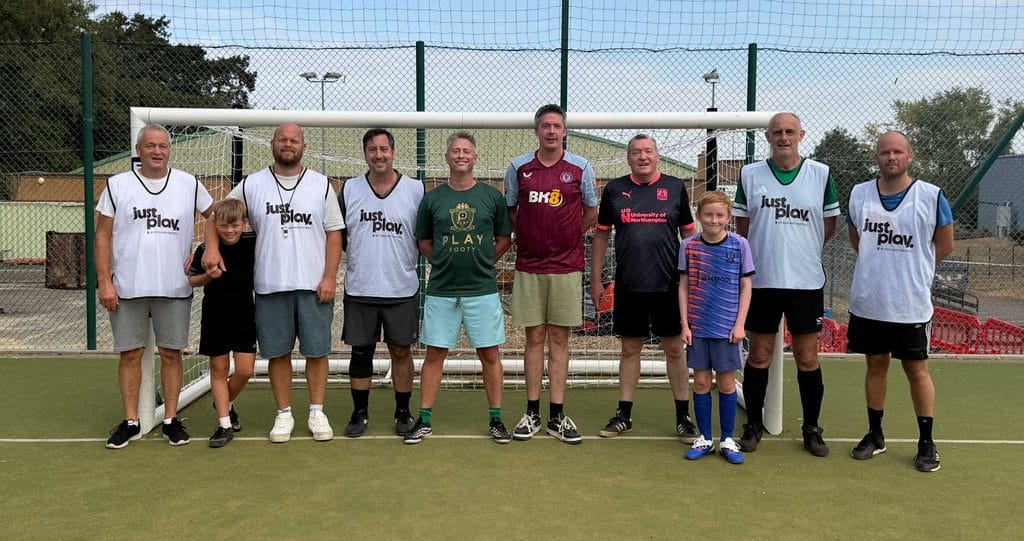
Play Footy FC runs sessions on Friday evenings at Guilsborough and Sunday mornings at Benham Sports Centre in Moulton through the FA Just Play programme. Sessions are open to adults of all ages and cost £5, largely to cover facilities and equipment.
Its busiest week so far attracted 25 players across the two sessions.
Demand is already beginning to pull the venture in another direction. Some players simply want an hour’s football each week. Others have begun asking for matches and tournaments. Play Footy is preparing to enter its first tournament, while Newman has been speaking to walking football clubs elsewhere in the country.
He sees potential for teams at different ages, with the over-40s particularly important because of his own experience.
But numbers are only part of what interests him.
Newman says something happens within minutes when people who have not played for years return to the pitch.
“They’re like a kid in a sweet shop,” he says.
“You can actually see the smile appear on their face.”
Then comes the old language of football. The stories, the teasing, the arguments about players and teams, the laughter.
For people whose weeks may otherwise consist largely of work and family responsibilities, Newman believes that hour has value far beyond the score.
There is a business lesson buried in his story too.
NewMan Active did not begin with a carefully mapped expansion into adult walking football. Play Footy emerged because the original idea did not work, Newman paid attention to what did, and his own experience helped him recognise a need that other people shared.
A sports hall booked for children’s coaching became a walking football session. A Facebook post became a regular group. A regular group is now becoming a club.
The opportunity, as Newman sees it, is to keep more people connected to football for longer.
“Somebody shouldn’t necessarily have to give up football because they’re 40, 50 or 60, because they’ve had an injury or because traditional football has simply become too physically demanding,” he says.
“At 39, after my stroke, I went looking for a way to continue playing football and couldn’t really find something that fitted me.
“Now, a few years later, I’m in a position where perhaps I can help create that opportunity for somebody else.”
His ambitions stretch from social sessions to age-group teams, leagues, tournaments and potentially trips to play clubs elsewhere in Britain. Alongside the group sessions, Play Footy also offers one-to-one coaching for children and adults, part of Newman’s wider ambition to create opportunities for people at every stage of the game.
But the measure Newman returns to is noticeably less complicated.
He wants somebody who comes to Play Footy to get some exercise, have a laugh, perhaps make a friend and want to come back the following week.
Or, as he puts it: “I want them to leave happier than when they arrived.”
For a venture born from a stroke, an empty sports hall and two children turning up to the wrong idea, it is not a bad business plan.
Find out more about Play Footy, including its walking football sessions and community, at playfooty.co.uk