What the Autumn Budget could mean for local businesses and families
By Luke Prout, Corporate Tax Partner, Cottons Group
With the Autumn Budget on 28 October, the rumour mill is in full swing. Our advice for local businesses and families: stay informed, plan early and act on facts rather than headlines.
Every autumn follows a familiar pattern. Weeks before the Chancellor stands up, the speculation begins. Capital gains tax will rise. Gifting rules will tighten. Your pension is in the firing line. Some of it turns out to be right. Plenty of it never happens.
This year is no different. The Autumn Budget lands on Wednesday 28 October, and commentators are already busy predicting what it will hold. At Cottons Group, we hear the same question from business owners and families across Northamptonshire and the Midlands. It’s less “what will change?” and more “how do I make sure I’m ready, whatever happens?”
What’s being talked about
The government has committed to not raising income tax, VAT or employee National Insurance, although the Chancellor has stopped short of ruling out tax rises altogether. With borrowing costs high, there are fewer big levers to pull, and many commentators expect a “breathing space” Budget built on smaller, targeted measures rather than sweeping reform.
Capital gains tax comes up again and again. Several advisory firms suggest it could change, whether through rates or exemptions, although most expect a modest shift rather than full alignment with income tax. There’s also talk of changes to how gifts are treated for inheritance tax, possible tweaks to property taxes at the higher end of the market, a decision on fuel duty, more detail on support for first-time buyers, and continued business rates relief for some sectors.
None of this is confirmed. At Cottons Group, we treat these as predictions, and Budgets have a habit of surprising everyone.
A quiet Budget isn’t a quiet year
If the commentators are right and this turns out to be a steady-as-she-goes Budget, that’s not the end of the story. Several economists have suggested the tougher decisions on tax and spending may simply be deferred into 2027. For business owners, that means uncertainty could linger well beyond 28 October, which is exactly why a flexible plan is worth more than a good guess.
What we already know
Some changes are already on the way, whatever happens on 28 October:
- Income tax thresholds stay frozen until April 2031, so more people will drift into higher tax bands as wages rise.
- From April 2027, most unused pension funds and death benefits will count towards an estate for inheritance tax.
- The cash ISA allowance for under-65s is set to fall to £12,000, with the full £20,000 still available across other ISA types.
- From April 2029, National Insurance relief on pension salary sacrifice will be limited to the first £2,000 of contributions.
For many families, these confirmed changes matter more than anything the rumours suggest.
What it could mean for local businesses
In our experience at Cottons Group, timing is often the biggest risk for owner-managed businesses. Commentators have noted that Budget uncertainty can prompt a rush of restructuring: holding companies, share buybacks, succession plans and group reorganisations that have sat on the “to do” list for months.
There’s sense in starting those conversations early. Many restructures need board approvals, shareholder resolutions and Companies House filings, and these take time. Wait until the week after the Budget and you may find everyone else had the same idea.
There’s equal sense in resisting a rushed decision. In previous years, people acted on rumours about pension tax-free cash that never came to pass. The smart move is to understand your options now, so you can act quickly and confidently once the detail is known.
What it could mean for families
For families, the conversation often turns to passing on wealth. Pensions entering the inheritance tax net from 2027 is already prompting many people to rethink their plans, and talk of changes to gifting and capital gains adds another layer. Parents and grandparents hoping to help younger family members onto the property ladder will also be watching for more detail on first-time buyer support.
The principle is the same as for businesses: plan with the rules as they stand today, keep your plans flexible and review them once the Budget is delivered.
Planning for your personal finances, too
This is exactly why Cottons Group is launching Cottons Wealth, our new financial planning arm. It brings our tax expertise together with chartered financial planning, so you can look at your business and personal finances in one place.
Whether you’re thinking about pensions, investments, retirement or passing wealth to the next generation, the Cottons Wealth team can help you understand your options and build a plan that holds up, whatever the Chancellor decides. You can register your interest on the Cottons Group website.
Join us after the Budget
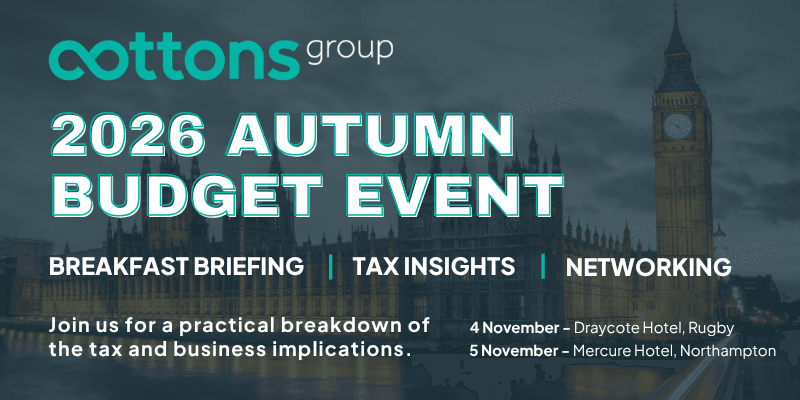
One week after the Budget, Cottons Group’s specialists are hosting two free breakfast briefings to explain what has actually been announced and what it means for you.
Luke Prout (Corporate Tax Partner), Jo Surley (Private Client Tax Director) and Giedre Azukaite (Chartered Financial Planner) will cover business tax, capital gains, personal allowances and financial planning, with plenty of time for your questions.
- Rugby: Wednesday 4 November, Draycote Hotel, 8am to 12pm
- Northampton: Thursday 5 November, Mercure Northampton, 8am to 12pm
Both events are free and open to all local businesses, not just Cottons Group clients. Breakfast is on us, and there’s time to network with other business owners.
Find out more and book your free place
Stay informed, plan ahead
Budgets come and go, but good planning lasts. The businesses and families who fare best are rarely the ones who guessed right. They’re the ones who understood their position, kept their options open and had an adviser on hand when it mattered.
To talk through your plans before or after the Budget, call Cottons Group on 01604 632116, email enquiries@cottonsgroup.com or visit cottonsgroup.com.
This article reflects commentary and predictions ahead of the Autumn Budget 2026 and does not constitute tax or financial advice. Please speak to an adviser before making any decisions.